Learn how to translate Youtube videos with proven strategies. Our guide covers transcription, translation methods, and multilingual SEO to grow your audience.
Translate Youtube Videos and Unlock Global Growth
Thinking about translating your Youtube videos? It’s far more than just ticking a box for subtitles. This is a deliberate move to solve a major problem for international viewers: the language barrier. By making your content accessible in different languages, you’re not just chasing higher view counts—you're building genuine connections, improving accessibility, and transforming your channel from a local voice into a global one.
Why Translating Your Videos Is a Growth Multiplier
Too many creators treat translation as an afterthought. In reality, it’s one of the most effective strategies you can use for exponential growth. This goes beyond simple metrics and gets to the heart of what makes a channel successful: community and accessibility.
When someone can watch your video in their native language, their experience is instantly better and more inclusive. That simple improvement can seriously boost your watch time and session duration—two of the most important signals the Youtube algorithm looks for when deciding to promote a video. By solving the language problem, you inspire loyalty and engagement.
Tapping Into Underserved Markets
Let's be honest: the English-speaking corner of Youtube is crowded. Getting noticed is a tough grind. But what if you could sidestep the competition? Countless non-English speaking markets are hungry for great content in their native language. These audiences aren't just waiting to be discovered; they're often incredibly engaged because high-quality, relevant, and accessible content is harder for them to find.
Take a market like the Netherlands, for example. In 2023, the country had around 7.021 million active Youtube users. That’s a massive, tech-savvy audience that many international creators completely ignore. Adding Dutch subtitles or a dubbed audio track is a direct line to that community, solving their need for localized content. You can find more data on the Dutch Youtube audience from Statista.
"Translating your videos isn't just about casting a wider net. It's about forging stronger connections with communities that are eager for content they can truly understand and relate to."
Gaining a Competitive Advantage
While your competitors are all fighting over the same English-speaking audience, you can be quietly building a loyal following in multiple countries. This approach diversifies your viewership, making your channel much more resilient if trends or algorithm updates hit a specific market.
Ultimately, to translate Youtube videos is to invest in the long-term health of your channel. It shows both your viewers and the platform that you’re serious about accessibility and global reach. This positions you as an authority not just in your niche, but in markets your competition hasn't even thought about yet. It's how you set the stage for sustainable growth.
Start with a Flawless Video Transcript
Before you even think about translating your Youtube videos, you need to solve one critical problem: getting a perfect source script. This is the bedrock of your entire translation project, and cutting corners here is a mistake you’ll pay for later. Any error in the original transcript won't just get carried over; it'll get magnified across every new language, creating a mess that can confuse viewers and damage your credibility.
It's tempting to just grab Youtube's free automatic captions. We've all been there. But honestly, they're often not up to the job. They can easily stumble over accents, mishear technical terms, or get confused by multiple speakers. Building your multilingual strategy on that shaky foundation is a recipe for frustration, leaving you to fix the same mistakes over and over in different languages.
The smarter, more productive move is to generate a clean, accurate transcript from the get-go. This ensures every translation you create starts from the correct words and context, solving the accuracy problem upfront.
The Power of a Dedicated Transcription Tool
Using a specialised transcription tool is hands-down the most efficient way to get a precise script. Instead of painstakingly typing out every word or fighting with Youtube's auto-caption errors, you can have an accurate, time-stamped transcript ready in minutes. This file becomes your single source of truth—a powerful asset for both accessibility and content repurposing.
Having this control from the start is a game-changer for your productivity. You can quickly go in and:
- Fix any misinterpretations of names, brands, or niche industry terms.
- Add proper punctuation, like commas and full stops, so the sentences flow naturally.
- Assign speaker labels in interviews or discussions to make it clear who is talking.
The few minutes you spend on this step will save you hours of headaches down the road. For a deeper dive into this, check out our guide on how to get a Youtube video transcript. A solid script makes the entire translation process feel less like a chore and more like a professional workflow.
Your Quick Review Workflow
Once you have your transcript, it's time for a quick review. Don't skip this. The goal isn't to rewrite your video but to polish the text for absolute accuracy before it goes off for translation.
The best way to do this? Play the video and read the transcript at the same time. It’s the fastest way to spot where things don't quite match up. Keep an eye out for common mix-ups that automated tools can miss, like homophones ("their" vs. "there"). Make sure the sentences are broken up logically and that each paragraph sticks to a single idea.
Remember, the quality of your translation can never exceed the quality of your source transcript. A few minutes spent refining the original text will save you hours of complex, multilingual corrections down the line.
Finally, do a quick pass to confirm all speaker labels are correct and consistent. A polished transcript doesn't just make your life easier; it gives any translation service—human or machine—a much better foundation to work from. The end result is a translation that your global audience can actually understand and connect with.
Choosing Your Translation Approach
Okay, you’ve got a spotless transcript ready to go. Now comes the big decision: how are you actually going to translate it? This choice will shape everything from your budget and timeline to how well your message connects with a new audience.
Honestly, there's no single "right" answer here. The best method really depends on your content, your goals, and your resources. You're looking at three main paths: letting a machine do the work, hiring a human expert, or a smart combination of both.
This decision tree gives you a quick visual of the workflow.
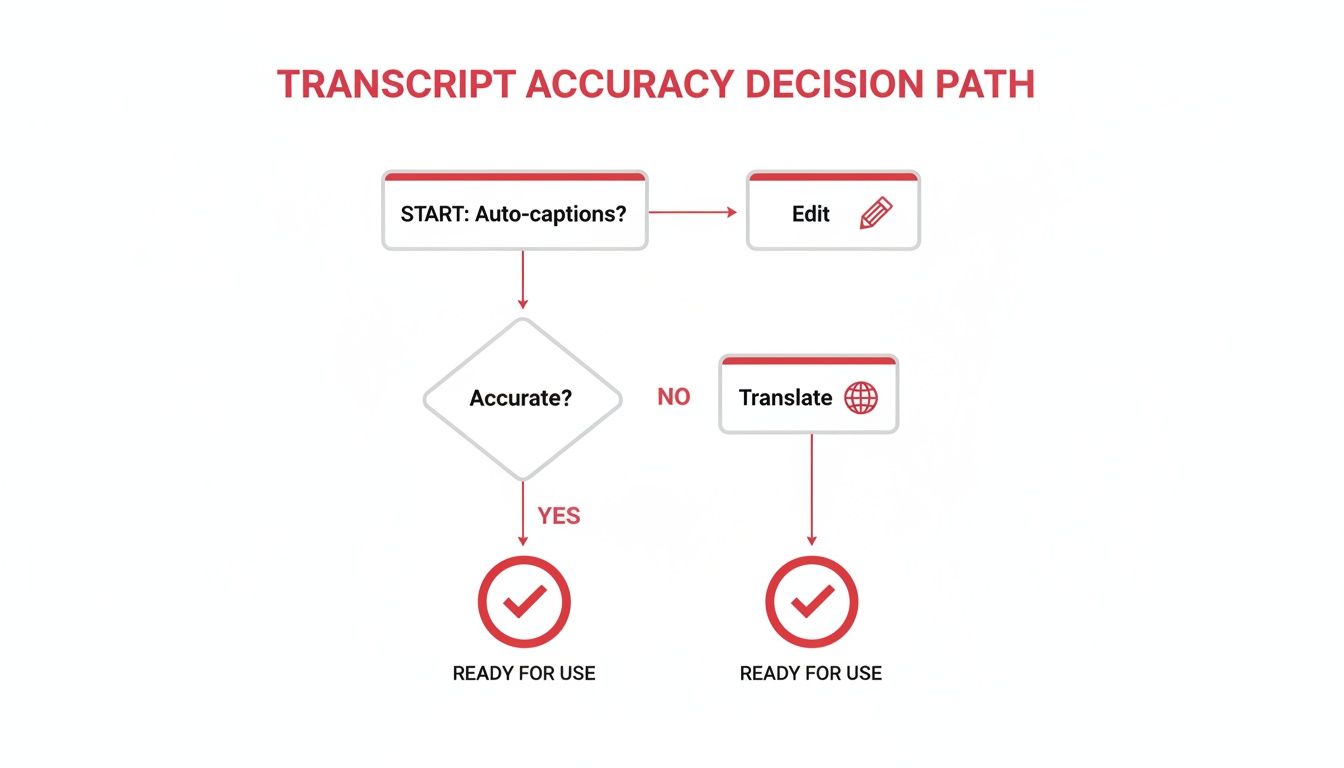
As you can see, a solid translation process always starts with an accurate transcript, whether you got there by cleaning up Youtube’s auto-captions or using a dedicated service from the get-go.
Pure AI Translation: The Need for Speed
When you need to solve the problem of time and budget constraints, AI is your friend. Tools like Google Translate or DeepL can churn out translations in seconds, making them perfect for handling a large backlog of videos or content where getting the general idea across is the main priority.
I find a pure AI approach works best for:
- Internal videos, like training materials where clarity trumps creative flair.
- Simple product demos or straightforward tutorials without a lot of slang or complex language.
- Getting a quick sense of what people are saying in your audience comments.
The catch? AI can be a bit tone-deaf. It often misses cultural nuances, humour, and industry jargon, which can lead to a translation that feels clunky or, worse, gets the facts wrong.
Professional Human Translation: When Quality Is Everything
For your most important content, the stuff that defines your brand, you simply can't beat a professional human translator. A real person understands the subtle jokes, cultural references, and specific tone that make your videos uniquely yours.
This is where I’d always invest the budget:
- Key marketing videos and brand advertisements.
- Highly creative or scripted content that relies heavily on storytelling and emotion.
- Detailed technical guides packed with specialised terms that an AI would likely mangle.
The trade-offs are, of course, time and money. Quality translation is a specialised skill, and it's priced that way. It's also much slower than an instant AI job, so you’ll need to factor that into your production schedule.
As technology improves, many creators are exploring AI-driven subtitle and translation workflows that help manage these projects more efficiently.
The Hybrid Approach: Getting the Best of Both
For most serious creators, this is the sweet spot. The hybrid model gives you a fantastic balance of speed, cost, and professional quality, solving the classic "fast, cheap, or good" dilemma.
The process is simple: you start by running your transcript through an AI translator to get a solid first draft. Then, you bring in a human expert to review, polish, and perfect it. This person isn’t starting from scratch; they’re focused on refining the AI’s work—fixing awkward phrasing, correcting cultural missteps, and making sure the tone is spot on.
This method is way faster and more affordable than a full human translation. We dive into how this works for specific language pairs in our guide on how to translate Romanian into English, but the principle applies everywhere. It’s a practical, cost-effective way to get high-quality results.
Comparing Translation Methods
To help you decide, here’s a quick-glance comparison of the three approaches. Think about what matters most for your specific video project.
| Method | Best For | Speed | Cost | Accuracy & Nuance |
|---|---|---|---|---|
| Machine (AI) Translation | Large volume, internal content, quick gists | Instant | Low / Free | Low to Medium |
| Human Translation | High-stakes marketing, creative content, technical guides | Slow | High | Very High |
| Hybrid (AI + Human) | Most business & creator content needing a balance of quality and efficiency | Medium | Medium | High |
Ultimately, choosing the right method comes down to aligning your translation strategy with your content's purpose. For a casual vlog, AI might be fine. For your company’s flagship product launch, a human touch is essential.
Crafting Professional Subtitle Files
Alright, this is where the magic happens. You’ve got your translated text, and now it’s time to turn it into a seamless part of the viewing experience. A clunky, poorly timed subtitle file can be just as distracting as a bad translation, completely pulling viewers out of your content.
What we're aiming for are subtitles that feel like they're not even there—appearing and disappearing in perfect sync with the dialogue.
To get this right, you need to understand the definition of a subtitle. It’s not just a block of text slapped on the screen. It’s a carefully timed caption that helps people understand what's being said without overwhelming them. It’s a real balancing act between readability, timing, and on-screen placement.
The good news? You don't have to sit there with a stopwatch, manually timing every single line. Modern tools can solve this productivity problem for you.
Instantly Generate a Time-Stamped File
You can take your plain text translation and, in moments, convert it into a standard subtitle format like SRT or VTT. Think of these files as simple text files but with added timing instructions that tell the video player exactly when to show and hide each line.
A dedicated converter tool handles all the heavy lifting for you. For a full breakdown of the process, check out this guide on how to convert a TXT file into a time-stamped SRT. This method gives you a fantastic starting point: a fully synchronised, but still raw, subtitle file that's ready for some fine-tuning.
This automated step gets you 90% of the way there. That last 10% is all about adding the professional polish that really makes a difference.
Refining Your Subtitles for Readability
With your initial SRT or VTT file in hand, open it up in a subtitle editor (or even a basic text editor) to make some crucial adjustments. This is where the human touch comes in to make sure the viewing experience is smooth.
Here are the key things I always focus on:
- Line Breaks & Character Limits: Nobody wants to read a wall of text at the bottom of the screen. Break longer sentences into shorter, more manageable lines. A good rule of thumb is to keep each line under 42 characters and stick to a maximum of two lines per subtitle block.
- Timestamp Synchronisation: Now, watch your video with the subtitles turned on. Does the text pop up just as someone starts talking? Does it vanish right after they finish? You'll likely need to nudge the start and end times a little to get the sync just right. Even a half-second delay can feel incredibly jarring to a viewer.
- On-Screen Placement: Keep an eye on the actual video content. Are your subtitles covering up something important, like a key visual or the presenter’s facial expression? While Youtube’s editor gives you some control over this, getting the timing perfect is the most critical part.
A personal tip I swear by: always read the subtitles out loud as you watch the video. It's the quickest way to spot awkward timing, unnatural line breaks, or phrasing that just doesn't land right in the moment.
This final pass is what separates the good from the great. When you translate Youtube videos, this attention to detail shows your new audience that you respect their time and want to give them a professional, accessible experience in their own language.
Getting Your Subtitles Live and Boosting Multilingual SEO
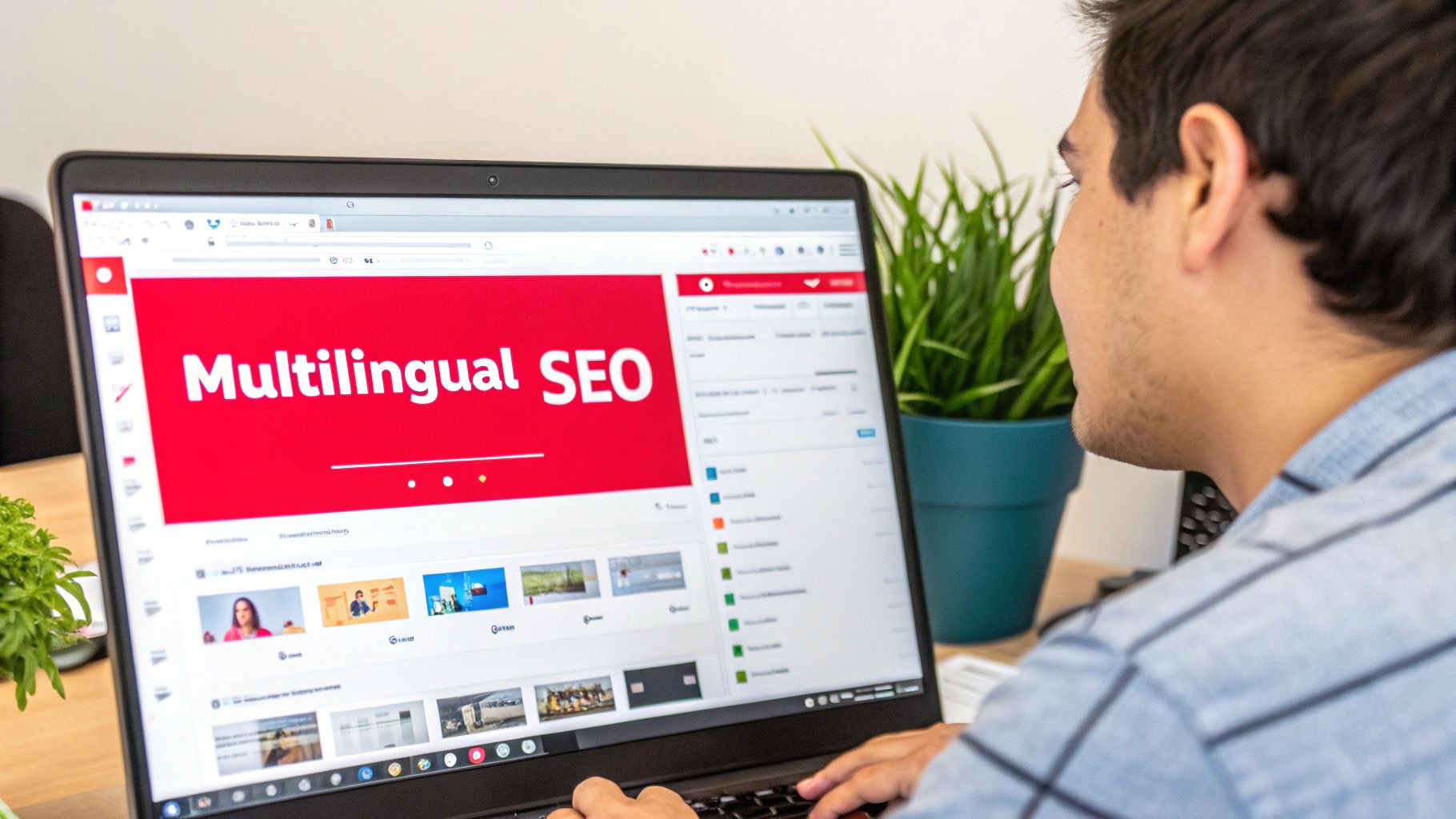
Alright, you've got your perfectly translated and timed SRT or VTT files ready to go. This next bit is the final technical hurdle, but it's also where your global strategy really kicks into gear. We're not just ticking a box for accessibility anymore; we're solving the problem of discoverability for entirely new audiences.
The process is pretty simple. Head over to your Youtube Studio, find the video you're working on, and click on the "Subtitles" tab in the left-hand menu. From there, hit "Add Language," pick the language of your new subtitle file, and upload it. Because you've already sorted the timestamps, Youtube will sync everything up automatically.
You can repeat this for as many languages as you want. Just like that, a single video can become a resource for viewers all over the world.
Thinking Past Subtitles to Multilingual SEO
Having subtitles in different languages is fantastic for accessibility, no doubt. But the real game-changer for growth is optimising your video's metadata for each of those languages. When you translate Youtube videos, you’re not just adding captions; you're creating a chance to show up in local search results where you were completely invisible before.
This means translating more than the on-screen text. Think about it: your video's title and description are huge for SEO. A viewer in the Netherlands isn't typing English keywords into the search bar; they're searching in Dutch. If all your metadata is in English, you're missing out on all that potential traffic.
The real aim here is to make your content feel native to each new audience. A translated title and description tells both viewers and the Youtube algorithm that your video is genuinely relevant to what they're looking for, in their own language.
A Smart Approach to Keyword Research
To pull this off properly, you need to get inside the head of your new audience. Simply pasting your English keywords into a translation tool won't cut it. That approach often completely misses the nuances, cultural context, and common search phrases people actually use.
Instead, you need to do a bit of digging for keywords specific to that country. How would a Dutch speaker actually search for your topic?
- Pinpoint Core Concepts: First, what's the central problem your video solves or the main idea it covers?
- Brainstorm Local Phrases: What are the common Dutch words someone might use for that concept? A great trick is to use an incognito browser window, set the language to Dutch, and see what Youtube's search bar suggests.
- Check Out the Local Competition: Look for successful Dutch channels in your niche. What kinds of keywords and phrasing do they use in their titles and descriptions?
This little bit of research makes all the difference. It helps you write a title and description that not only describe your video accurately but also line up perfectly with what your new audience is already searching for. This is how you move from just adding a translation to strategically launching your content in a brand-new market.
Common Questions About Youtube Translation
Even with a clear plan, jumping into video translation can feel a bit daunting. Let's solve some of the most common problems and answer the questions that pop up, so you can move forward confidently.
First off, a big one: do I really need to translate every single video? The short answer is no. A much better strategy is to focus your efforts where they'll have the biggest impact. Start with your heavy hitters—the videos that are already pulling in great views and engagement. Translating these first gives you the best chance of a quick win.
Another question I hear all the time is about quality. Just how accurate do these translations need to be?
Will Machine Translation Hurt My Brand?
This is a totally valid concern. Nobody wants their channel to look cheap or careless, and a clunky, awkward translation can do more harm than good. It can make viewers cringe and click away.
The trick is to think of AI as your super-fast first drafter, not the final editor. A raw machine translation will almost never be perfect. It's notorious for missing cultural nuances, industry-specific jargon, or even the subtle humour you've worked into your script.
My advice? Always go for a hybrid approach. Use a tool to get the initial translation done quickly and affordably. Then, and this is the crucial part, have a native speaker review and polish it. They'll catch the weird phrasing and make sure the subtitles sound genuinely human, protecting the voice and quality of your brand.
Is It Worth Translating Video Titles and Descriptions?
Yes, 100%. This is probably the most overlooked part of the process, but it’s a massive lever for growth. Your title and description are your front door for search. If they’re only in English, you're invisible to millions of people searching for your content in their own language.
Here's why this small step is non-negotiable:
- Get Found: A translated title means your video actually shows up when someone in another country searches on Youtube.
- Boost Clicks: People are naturally more likely to click on a search result they can actually read and understand.
- Feed the Algorithm: It’s a powerful signal to Youtube that your video is relevant for a specific audience, which helps it get recommended more in that region.
Think of it like this: subtitles make your video understandable once someone finds it, but a translated title and description are what help them find it in the first place.
Ready to open up your channel to a global audience? Get started with YoutubeToText and get your first accurate transcript back in minutes. Solve the accessibility barrier, unlock new markets, and grow your channel by visiting https://youtubetotext.ai.